
Introduction
More than simply great food, the industry has always been giving on prices, promotions, and customer engagement. The consumer is being pampered in this era of food delivery applications and digital-first dining. He does not look into restaurants just for menus or ratings; he prefers instead to compare deals, discounts, and coupons before making a purchase.
Now, promotions have become much more—they have turned into a potent strategic weapon. This is exactly why platforms such as Zomato, Swiggy, Uber Eats, Talabat, and Deliveroo host hundreds of deals daily, encompassing offers like free buys, cashback, and surges due to dynamic discounts.
But then, with so many scattered and numerous deals, how can anyone track the competitor’s promotions at scale? And how can one ensure that his deals are enticing without forcing himself to offer excessive discounts?
This brings us again to Restaurant Deal Scraping API—here’s a tool for automation in the collection of coupons, offers, and promotional data across platforms. While employing scraping APIs to systematically and in real time collect, clean, and analyze deals, discover more price cuts, and craft promotions more intelligently.
Why Promotions and Deals Matter in the Restaurant Industry
Deals are more than just discounts—they’re a psychological trigger. A well-timed coupon can:
- Attract customers who are first-timers and may not even have placed an order.
- Push average order values through bundles or combo offers.
- Retain those customers by instilling their loyalty.
- Draw in volume during off-peak hours through after-hours promotions.
In highly competitive markets like India, the UAE, or the US, it is usually the promotion that draws a patron to Restaurant A against Restaurant B.
While scrappers and APIs keep deals in rapid flux, pricing and promotions may be used) by restaurants strategically so that they remain competitive without closing down their margins.
What Is a Restaurant Deal Scraping API?
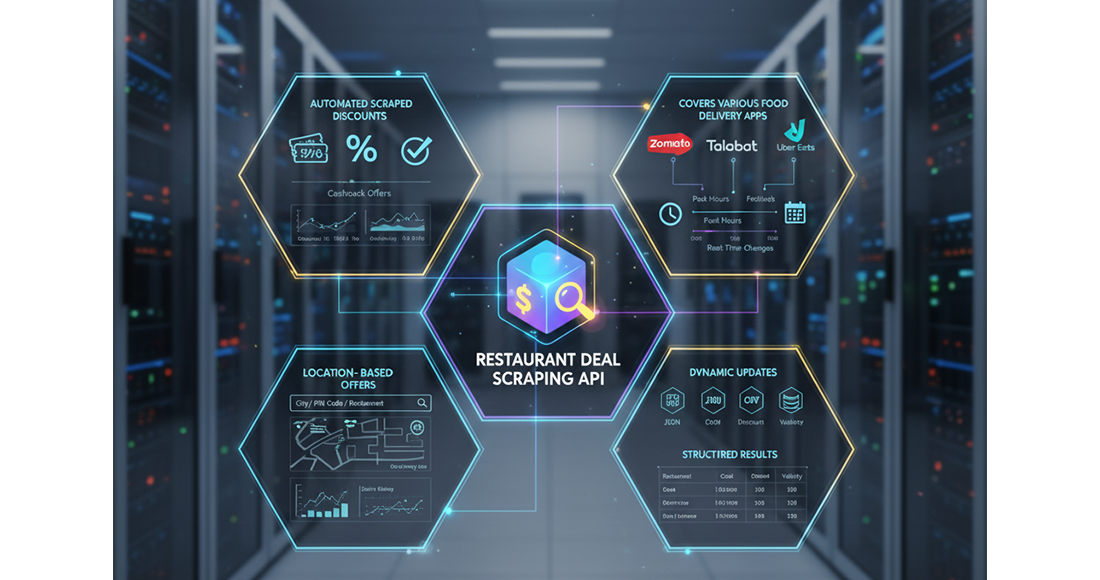
Scraping a restaurant deal API is an automated system that collects structured records of discounts, coupons, and offers from food delivery apps, aggregator platforms, and restaurant websites.
The API can collect and organize what would have taken hours to gather and record manually into data optimized for straightforward analysis.
Key Features:
- Automated Scrape Discounts: Get coupon codes, discount percentages, and cashback offers.
- Covers Various Food Delivery Apps: Get deals from Zomato, Swiggy, Talabat, almost-doom, Deliveroo, and Uber Eats.
- Location-based Offers: pin code, city, and food number appear in this section, while the delivery radius can be displayed.
- Dynamics Updates: changes in offers during peak hours or festivals.
- Structured Results: Get clean data in JSON, CSV, or straight in your analytics dashboard.
What Data Can Be Scraped with a Deal API?
- Coupon Codes
- Percentage discounts (e.g., 20% OFF).
- Flat discounts (e.g., ₹100 OFF).
- Free delivery offers.
- BOGO & Combo Deals
- Buy one, get one free.
- Meal bundles (e.g., pizza + drink combo).
- Cashback & Wallet Offers
- Bank/UPI-specific deals.
- Cashback into app wallets.
- Time-Sensitive Promotions
- Lunch-hour discounts.
- Weekend-only offers.
- Platform-Specific Offers
- Swiggy SUPER or Zomato Gold exclusives.
- Loyalty reward discounts.
- Regional & Seasonal Campaigns
- Festive offers (Diwali, Ramadan, Christmas).
- Summer/winter specials.
How Does a Restaurant Deal Scraping API Work?
- Identify Platforms
Choose which apps or sites to monitor (Swiggy, Deliveroo, Talabat, etc.). - Collect Offers
API crawls and extracts promotional data across multiple restaurants. - Normalize Data
Clean and structure different formats (e.g., percentage discounts vs. flat amounts). - Integrate
Feed scraped data into CRM, pricing engines, or BI dashboards. - Analyze & Act
Compare offers against competitors, adjust campaigns, and measure ROI.
Use Cases of a Restaurant Deal Scraping API
1. Competitive Benchmarking
Monitor how competitors use discounts and identify gaps in your strategy.
2. Dynamic Pricing & Promotions
Adjust offers in real time based on competitor actions.
3. Festival Campaign Planning
Scrape historical data to design winning festive offers.
4. Loyalty & Retention Strategies
Analyze which types of deals resonate most with customers.
5. Cost Optimization
Identify ineffective promotions and cut back on discount overspending.
6. Franchise & Chain Management
Ensure consistency in offers across multiple outlets.
Benefits of Automating Deal Collection
- Time Savings
Replace hours of manual monitoring with instant data feeds. - Accuracy
Avoid human errors in recording competitor promotions. - Scalability
Track thousands of deals across multiple cities at once. - Real-Time Intelligence
Stay updated with live offer changes, including flash sales. - Improved ROI
Spend smarter on promotions that actually drive conversions. - Customer Retention
Offer deals that align with consumer expectations.
Challenges in Restaurant Deal Scraping
- Platform Restrictions: Food apps may block excessive scraping.
- Dynamic Promotions: Offers change frequently, requiring regular scraping.
- Data Cleaning: Different platforms represent offers differently.
- Scalability: High volumes of promotions need a strong infrastructure.
- Legal Considerations: Scraping must align with terms of service and data laws.
Best Practices for Restaurant Deal Scraping
- Define Goals Clearly
Focus on specific insights (e.g., cashback offers, BOGO deals). - Automate Regularly
Schedule scraping at hourly or daily intervals. - Ensure Data Quality
Deduplicate and normalize for easy comparison. - Stay Compliant
Use ethical scraping practices that respect laws. - Visualize Insights
Use dashboards to track promotions in real time. - Partner with Experts
Outsource scraping to vendors who specialize in food industry data.
The Future of Restaurant Deal Intelligence
In the next phase, deal scraping APIs will merge with AI and predictive analytics:
- Dynamic Promotions: AI-driven offers tailored in real time.
- Predictive Discounting: Forecasting which deals will perform best.
- Personalization: Creating customer-specific coupon codes.
- Automated Campaign Testing: AI will run A/B tests using scraped competitor data.
For restaurants and delivery platforms, data-driven promotions will become as important as the food itself.
Scaling Businesses with Deal APIs
For single restaurants, scraping helps design smarter offers. For multi-chain brands, it ensures consistency across outlets while adapting to local competition. For delivery platforms, it sharpens algorithms that rank and display restaurants based on active deals.
Ultimately, a restaurant deal scraping API isn’t just about tracking discounts—it’s about turning promotions into profit engines.
Conclusion: The Power of Food Data Scraping
Promotions and deals hold immense scope for contributing positively towards the growth of a restaurant. Thanks to the introduction and availability of online social systems, many promotions and deals provided by various food and beverage outlets can be reviewed independently and compared between one outlet and the other.
A Restaurant Deal Scraping API solves this challenge by:
- Automating coupon and offer collection.
- Normalizing dynamic data across multiple platforms.
- Powering smarter, data-driven promotional strategies.
The core mechanism for this change is dubbed Food Data Scraping, which is turning raw promotional data into actionable insights for restaurants, chains, and delivery platforms. More than merely listing secret deals, Food Data Scrapping will be unlocking exponential opportunities for sustainable growth for these entities in a fiercely competitive dining arena.