

Introduction
Quick commerce, or q-commerce, has fundamentally changed how consumers purchase groceries, personal care goods, and daily necessities. Zepto, Blinkit, Instamart, Getir, Gorillas, and Rappi have perfected the art of instant gratification, promising deliveries in 10 to 20 minutes. World-class services aside from these must combine speed and convenience, even while having their own sets of return and refund issues.
Returns and refunds scenarios provide ample information. From packaging damage to expiry and wrong products, these events are sources of data, which are very precious for the business. By scraping APIs from quick commerce platforms, companies can derive insights from return and refund trends into customer dissatisfaction, supply chain weaknesses, and product quality issues.
In this blog, we’ll explore why return/refund data matters, what APIs reveal, how scraping works, challenges involved, best practices, use cases, and why Food Data Scraping is at the center of transforming these raw signals into actionable intelligence.
Why Return and Refund Data Matters in Quick Commerce
Return and issue with refunds are often viewed as operational trouble. Yet, they are a data gold mine. Every return tells a tale: a product may have failed to live up to the expectations, may have been delivered late, or its price may have been wrong. Analyzing such tales from a large sample enables businesses to:
- Identify Supply Chain Gaps: Find where delays, mishandling, or errors occur.
- Monitor Product Quality: Spot products or categories with frequent complaints.
- Track Vendor Performance: Evaluate suppliers based on refund rates.
- Improve Customer Experience: Adjust policies or processes based on dissatisfaction drivers.
- Forecast Costs: Understand how refunds impact margins and design mitigation strategies.
For platforms functioning in multi-city or multi-country settings, scaling requires the utmost attention to return/refund analyses to stay efficient and retain customer confidence.
What Data Can Be Scraped from Return/Refund APIs?
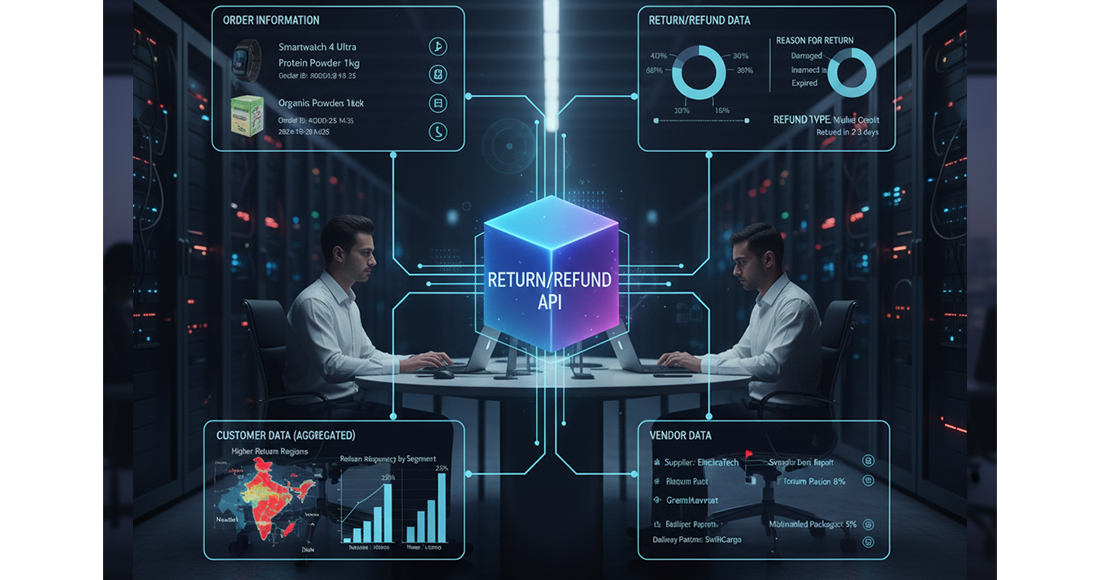
Quick commerce platforms maintain extensive data systems to track returns and refunds. Scraping their APIs can reveal:
Order Information
- Order ID, product details, category.
- Date and time of purchase.
Return/Refund Data
- Reason for return (expired, damaged, incorrect item).
- Refund type (cashback, wallet credit, replacement).
- Refund timelines.
Customer Data (Aggregated/Anonymous)
- Location trends (which regions face higher returns).
- Frequency of returns by customer segments.
Vendor Data
- Supplier names linked to returned products.
- Supplier-specific return/refund ratios.
Delivery Insights
- Delivery partner information.
- Late or mishandled delivery reports linked to refunds.
Together, these form a return/refund dataset that provides deep operational and consumer insights.
How Scraping APIs for Return/Refund Trends Works
Step 1: Identify Target Platforms
Choose quick commerce apps relevant to your business, such as Zepto, Blinkit, Getir, or Rappi.
Step 2: Access APIs
- Some platforms provide partner APIs for order and refund data.
- In most cases, businesses build custom scraping APIs to capture relevant endpoints.
Step 3: Extract Data Fields
APIs usually return JSON responses that include product IDs, return reasons, and refund statuses.
Example (pseudo-code in Python):
import requests
url = “https://api.quickcommerce.com/v1/refunds?location=Delhi”
headers = {“Authorization”: “Bearer YOUR_API_KEY”}
response = requests.get(url, headers=headers)
data = response.json()
for refund in data[‘refunds’]:
print(refund[‘order_id’], refund[‘product_name’], refund[‘reason’])
Step 4: Normalize and Clean
- Standardize return reasons across platforms (e.g., “expired” vs. “past shelf life”).
- Normalize product categories.
- Remove duplicate entries.
Step 5: Store in Databases
Use MySQL, MongoDB, or cloud solutions for large-scale return/refund datasets.
Step 6: Analyze
Visualize refund trends with BI tools or use machine learning models to predict high-risk categories.
Common Trends in Quick Delivery Returns
Scraping refund APIs across platforms often reveals patterns such as:
- High Returns in Fresh Produce: Fruits and vegetables are prone to damage or spoilage.
- Expired Packaged Goods: Items with short shelf lives often get flagged.
- Mismatched Orders: Fast fulfillment increases chances of incorrect items.
- High Returns in Certain Categories: Perishables and personal care items see higher complaint ratios.
- Seasonal Refund Spikes: Festivals bring bulk orders, often resulting in higher return volumes.
Understanding these trends helps businesses target weak links in the ecosystem.
Use Cases of Return/Refund Data Scraping
Restaurants & Cloud Kitchens
- Track ingredient quality sourced from q-commerce platforms.
- Avoid vendors with high return ratios.
FMCG Brands
- Monitor how their SKUs perform across platforms.
- Identify if competitor products face fewer returns.
Retailers
- Align in-store quality with online customer expectations.
- Adapt packaging to reduce damages.
Delivery Platforms
- Benchmark delivery partners based on complaint trends.
- Optimize last-mile operations.
Investors & Analysts
- Assess operational efficiency of q-commerce platforms.
- Use refund ratios as a metric for sustainability.
Benefits of Scraping Return/Refund APIs
- Proactive Problem Solving
Address issues before they escalate into widespread dissatisfaction. - Operational Efficiency
Reduce losses linked to returns by improving logistics. - Supplier Accountability
Hold vendors responsible for consistent product quality. - Customer Retention
Improve trust by minimizing errors and delays. - Strategic Forecasting
Use historical return trends to predict future challenges.
Challenges in Scraping Return/Refund Data

- API Rate Limits: Restrictions on daily calls.
- Data Complexity: Returns involve multiple layers (products, logistics, refunds).
- Platform Defenses: CAPTCHAs, IP blocking, or bot detection.
- Regional Variations: Different return/refund policies across geographies.
- Compliance Risks: Must adhere to data privacy laws like GDPR.
Best Practices for Return/Refund Data Scraping
- Define Goals Clearly
Are you analyzing refund costs, product quality, or delivery issues? - Automate Regular Updates
Schedule scraping daily to reflect current issues. - Normalize Data Across Platforms
Standardize return reasons and product categories. - Use Proxies & Rotating IPs
Scale without triggering platform defenses. - Ensure Compliance
Follow ethical scraping standards and local regulations. - Leverage Predictive Analytics
Use machine learning to anticipate refund spikes. - Collaborate with Experts
Partner with specialized scraping providers for accuracy and scalability.
Regional Insights from Return/Refund Scraping
- India (Zepto, Blinkit): Fresh produce dominates returns due to perishability.
- Europe (Getir, Gorillas): Sustainability complaints arise around packaging waste.
- Middle East (Talabat Mart): Festival surges create higher refund volumes.
- Latin America (Rappi): Returns often tied to cross-category errors (groceries, pharmacy).
These insights allow businesses to compare cross-country patterns and adjust strategies accordingly.
The Future of Return/Refund Data Intelligence
As quick commerce matures, return/refund data will integrate with AI and automation to deliver predictive insights.
- AI-Powered Quality Checks: Predict which SKUs are most at risk of refunds.
- Dynamic Supplier Scoring: Automatically rank vendors based on return performance.
- Personalized Policies: Adjust return policies for loyal vs. new customers.
- Supply Chain Synchronization: Prevent refunds by aligning procurement with predictive demand.
Future-ready businesses will not only react to refunds but anticipate and prevent them.
Scaling Businesses with Return/Refund Data
For small restaurants, refund scraping ensures ingredient quality. For cloud kitchens, it allows scaling without compromising consistency. For FMCG brands, it reveals SKU weaknesses across geographies. For investors, it provides early warning signals about platform sustainability.
In all cases, return/refund trend analysis drives smarter, more resilient strategies.
Conclusion: The Role of Food Data Scraping
Returns and refunds are often viewed as losses, but in reality, opportunities for insights lie there. Quick commerce platforms have the potential to yield enormous datasets concerning return reasons, refund policies, and complaint trends in various regions. Businesses can make use of scraping APIs efficiently to enable them to transform this raw information into their competitive advantage.
By doing so, they can:
- Identify weak links in supply chains.
- Hold suppliers accountable for quality.
- Improve customer trust with proactive solutions.
- Scale strategically with predictive intelligence.
At the heart of this transformation lies Food Data Scraping—the process of converting fragmented return/refund signals into structured, actionable insights. For restaurants, FMCG brands, retailers, and analysts, food data scraping is not just about reducing refunds—it is the foundation for long-term growth and customer loyalty in the quick commerce era.
Leave feedback about this