

Introduction
Pricing strategy refers to pricing depending on the digital-first food competition because most restaurants’ lives hang in the balance. With all food delivery apps-on Swiggy, Zomato, Uber Eats, Talabat, Deliveroo, and the lot-changing the consumer’s restaurant choices daily, restaurant menu prices have to change in real time. Prices bounce up and down according to demand, any offers running, supply chain costs, and even strategies to piggyback on competitors.
It also creates new challenges with opportunities for existing companies, FMCG, cloud kitchens, and even analysts: The problem is that manually tracking prices across multiple platforms is almost impossible. This is exactly where real-time restaurant menu scraping happens. With restaurant menu scrapers and APIs, businesses can easily automate the process by extracting live pricing data from food delivery apps and create a restaurant menu dataset that truly mirrors the real market dynamics.
In this blog, we’re going to handle how scraping is done by a restaurant menu, why that is significant, and therefore anyone interested in a dish can monitor those changes in creating better promotions and gain some competitive edge in food delivery.
The Growing Importance of Restaurant Menu Scraping
Consumer is armed with a biological costlier empathy. A very small change in prices may tilt the balance towards competitors in the case of meals. Delivery service apps are very clear when it comes to pricing, discounts, delivery charges, and promotional charges.
Menu scraping renders it easier for a business to track, analyze, and construct a fast response to monitoring competitor pricing changes. This allows them to monitor some menu elements on the basis of restaurant menu dataset creation, scan prices across items during festivals, check which product categories have the maximum number of discounts, etc.
This intelligence, therefore, has implications not only for restaurants but also for FMCG brands having their products listed on delivery platforms, cloud kitchens harshly challenging on costing, and generally for market research styles aimed at studying urban consumer behavior.
How Real-Time Menu Scraping Works
Fundamentally speaking, scraping restaurant menu data involves using automated techniques to access and collectively retrieve well-structured data from websites dealing with food delivery. Such mechanisms are often called restaurant menu scrapers that scan delivery interfaces such as applications and portals, identify and retrieve the key elements, i.e., names of the dishes, costs, offers, classification, availability, and then convert the structured data into a usable form.
This information is such that data once retrieved acts as a base file of the restaurant and is on databases or spreadsheets that are regularly updated. Hence, it is quite different from the traditional charts and graphs that are published as data, as in such scenarios, the business intelligence tool will always have up-to-date information.
As an illustration, in case any rival organization offers a lunchtime discount on pizzas for the city of Bangalore, the restaurant menu scraper would detect this difference in pricing, which would, in turn, enable organizations to take corrective measures or adjust the rates of the same dishes.
Price Fluctuations in Food Delivery Apps
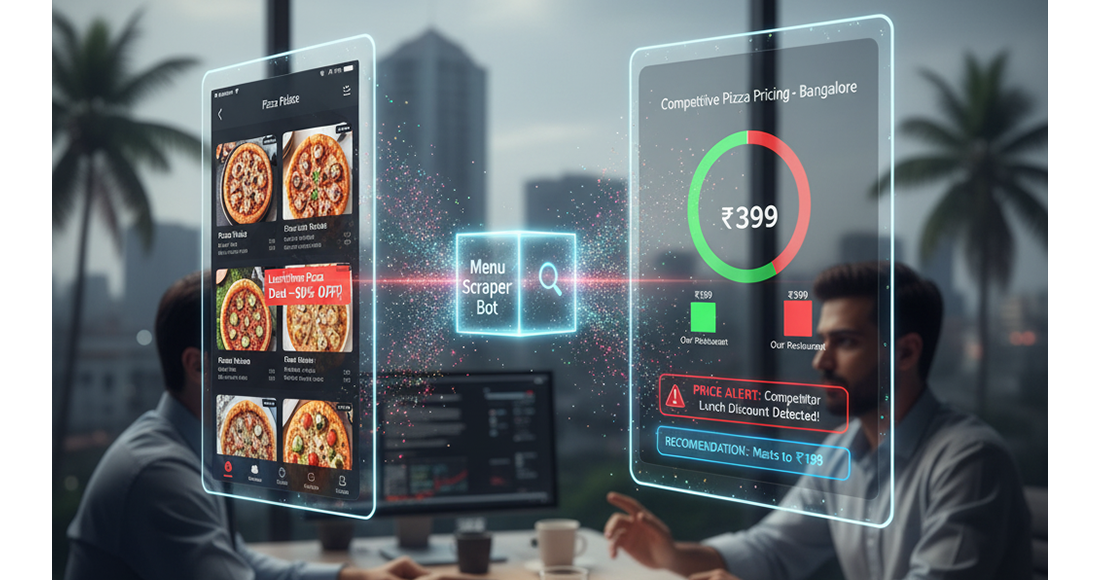
Food delivery apps are a lustrous, on-the-go instant technology with prices inclined across multiple service dynamics. This alteration includes constant repricing by the restaurants and carries variables of demand, logistics service costs, or competition. Sometimes the aggregators themselves give out those promotional discounts or bank offers and might even carry some surge pricing just to feed off the behavior of the customers.
The frequency of the cycles can be many times within a single day, too. For example, a dish might cost ₹200 in the morning and then drop to ₹180 by early afternoon, including the discount, and in the evening, it would climb back up to ₹200 or even higher. Connections are easily missed without restaurant menu extraction tools, which contributes greatly to the intelligence levels based on the hyper-granular.
By scraping the restaurant menu data continuously, companies can inquire where those changes are, compare their bench with what is happening, and develop their strategy to face the competitive edges.
Building a Restaurant Menu Dataset
Restaurant reservation scraping may not evolve more than this one output. It happens because when the menu is scraped out, an extremely valuable restaurant menu dataset is created. An invaluable asset for evaluating thereon, the analysis gave insights into maintenance in pricing, promotions, and demand elasticity in different regions across time, owing to the significant amount of analysis that can be done thereby.
For instance, it might be that the dataset indicates that while every weekend sees fluctuation in prices of biryani in Mumbai, in Delhi, absent any festival, one could observe that they offer the highest discounts on fast-food combos. By adopting the dataset, restaurants can possibly regulate dynamic pricing, launch promotions effectively timed, and introduce newer dishes in line with consumer expectations.
Thereby, market analysts and FMCG brands find the dataset useful to the study of local consumption patterns and sensitivity to prices, which directly impacts new product creation and marketing efforts.
Why Restaurants Need Real-Time Price Monitoring
Restaurants operate in one of the most competitive sectors in e-commerce. Without real-time monitoring, they risk being undercut by competitors who adopt aggressive pricing strategies.
By using restaurant menu scrapers to monitor price changes, restaurants gain the ability to:
- Avoid overpricing, which can drive away customers.
- Detect underpricing trends that could hurt margins.
- Optimize promotions to match or outperform competitors.
- Respond quickly to seasonal price fluctuations.
Essentially, restaurant menu scraping transforms price monitoring from a reactive task into a proactive strategy.
Impact on Cloud Kitchens and Delivery-First Brands
Kitchens without the dine-in feature know how to keep their revenue dependent entirely on complementary drops until the median food delivery platforms. The most critical is the menu pricing intelligence. A popular dish has as little as ₹10, which can cause a swing of hundreds of orders per day.
They can conduct thorough competitor menu tracking across multiple platforms by leveraging restaurant menu extraction here, allowing them to see where in their pricing strategies they do not cover-and then attend a fine-tuning procedure. For example, if many of their rivals are giving 50 percent off on weekends on burgers, a cloud kitchen might offer combo options or set prices scientifically to retain customers.
It is just possible to be agile through scraping the menu in real time.
Benefits for FMCG Brands and Retailers
When it comes to scraping restaurant menus, it is equally important for FMCG brands and grocery retailers to play their cards right. Alongside restaurant menus, many delivered items like beverages, snacks, or ready-to-eat meals from various companies are up.
FMCGs, through the scraping of menu data, could access the data they priced versus their competitors. It can also help to identify regional demand trends and track discounts during promotions. For example, a brand involved in the production of non-alcoholic beverages could learn that its competitors routinely paired their colas with pizza at a price lower than its price, thereby provoking them to do something quite similar.
Retailers can also make compelling use of restaurant menu datasets in properly adjusting the prices of stores in terms of online competition for discovery and uniform competitiveness.
Challenges in Restaurant Menu Scraping
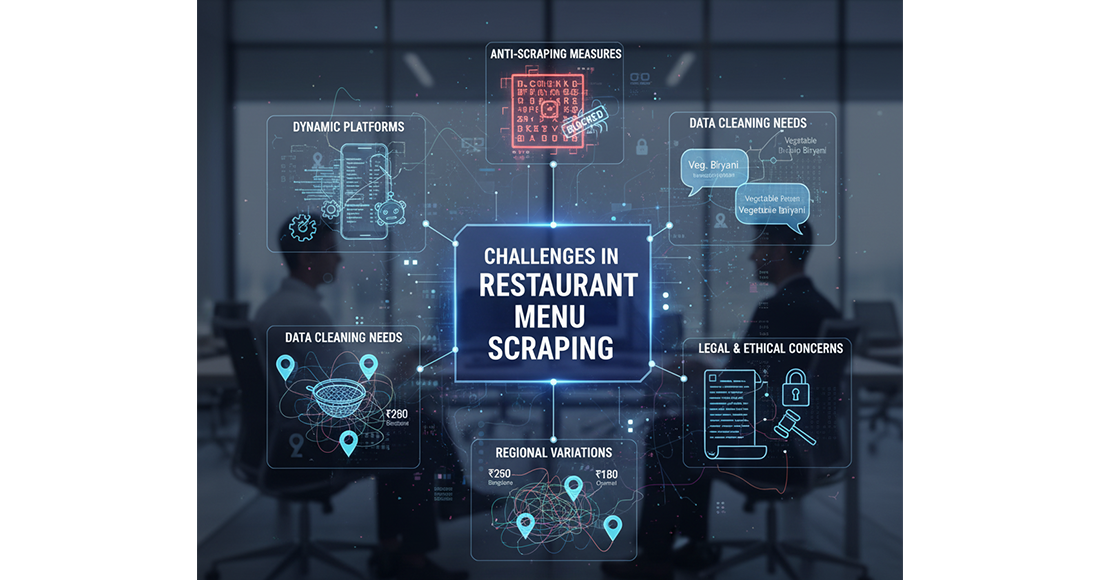
Despite its benefits, restaurant menu scraping comes with challenges:
- Dynamic Platforms: Delivery apps update menus and prices constantly, requiring scrapers to adapt.
- Anti-Scraping Measures: Platforms use CAPTCHA and bot detection to block unauthorized scrapers.
- Data Cleaning Needs: Extracted data often requires normalization (e.g., “Veg Biryani” vs. “Vegetable Biryani”).
- Regional Variations: Prices vary by city and even PIN code, making large-scale scraping complex.
- Legal & Ethical Concerns: Scraping must align with terms of service and local data regulations.
Businesses need robust scraping strategies and compliance-focused partners to overcome these challenges.
Best Practices for Restaurant Menu Extraction
To succeed with restaurant menu scraping, businesses should:
- Define Objectives: Focus on categories or competitors most relevant to the business.
- Automate Updates: Schedule scraping frequently to capture real-time price changes.
- Normalize Data: Standardize dish names, sizes, and units for accurate comparison.
- Use Ethical Scraping: Respect legal frameworks and platform policies.
- Leverage Analytics Tools: Convert raw datasets into insights using BI dashboards.
- Partner with Experts: Work with specialized providers for large-scale menu extraction projects.
By following these practices, businesses can build reliable restaurant menu datasets that fuel growth.
The Future of Restaurant Menu Scraping
As technology evolves, restaurant menu scrapers will integrate more with AI and machine learning. This will allow businesses to not just monitor but also predict price changes and consumer behavior.
Future innovations may include:
- Dynamic Pricing Engines that adjust restaurant menus in real time.
- AI-Powered Sentiment Analysis linking customer reviews to pricing strategies.
- Personalized Promotions driven by hyperlocal demand data.
- Automated Procurement Systems that align supply chains with menu data.
By 2030, restaurant menu scraping will move from tracking prices to shaping entire pricing ecosystems across food delivery apps.
Conclusion: The Role of Food Data Scraping
The food delivery industry has entered an era of constant competition, where pricing agility is essential for survival. With prices fluctuating across apps like Swiggy, Zomato, Uber Eats, and Talabat, restaurants and brands can no longer rely on static strategies. They need real-time restaurant menu scraping to stay competitive.
By building robust restaurant menu datasets, businesses can:
- Monitor competitor prices continuously.
- Align promotions with market demand.
- Optimize menus for profitability and consumer appeal.
- Gain insights into regional and seasonal pricing patterns.
At the heart of all this lies Food Data Scraping—the engine that turns raw online menu listings into structured, actionable intelligence. For restaurants, cloud kitchens, FMCG brands, and analysts, food data scraping is not just a technical process—it is the foundation of smarter decision-making and sustainable growth in the food delivery economy.
Leave feedback about this