

Introduction
In the past, restaurants have been dependent on demand, taste trends, and location strategy. But the competition has really escalated since 2025, with delivery being the primary mode of order fulfillment and delivery platforms becoming the most-used customer channels-Swiggy, Zomato, Uber Eats, DoorDash, and Grubhub. A restaurant is no longer just competing with another on the street beside it; quite often, restaurants in the same delivery radius compete with dozens and sometimes hundreds.
Two factors are crucial to success in this crowded space:
- Location intelligence: where to set up the next store to generate maximum demand with minimum competition.
- Menu gap analysis: what to offer (or stop offering) to fulfill unfulfilled customer demand.
Before, in time, restaurants acted mainly on instinct, conducted some surveys, or relied on third-party reports to make these decisions. But now the most successful brands use web scraping technology to gather real-time structured data from food delivery apps, competitor websites, and review platforms.
When looking at how information drawn from the county list enables location analysis and gap identification for various menus, you might want to consider how web scraping furthers restaurant growth, its advantages, and why any data-driven method must be embraced for success in the long run.
Why Location Matters More Than Ever
Location has always been the most important factor affecting restaurant business. It must be said that if any eatery is difficult to reach with their creations, they cannot generate sales. Delivery-first dining has only complicated the whole issue of location.
- Delivery Radius Limitations: These apps often restrict deliveries within a 5- to 10-km radius. Depending upon your outlet’s location, you determine your customer base.
- Urban Density Challenges: Larger cities celebrate the presence of at least 50 establishments within a neighborhood serving similar cuisine.
- Regional Tastes: Regional food preferences are highly disparate (for instance, higher demand for vegetarian items in Gujarat as compared to non-vegetarian demand in coastal cities).
- Cost Structures: Rent, labor, and ingredient sourcing vary from city to city, thus affecting profitability.
Without precise information, some restaurants may set up outlets in already crowded areas, while others may delay entry into neighborhoods that are underserved.
Why Menu Gap Analysis Is Critical
While location drives access, the menu defines desirability. Offering the wrong set of dishes can result in wasted resources and lost opportunities.
Menu gap analysis answers key questions:
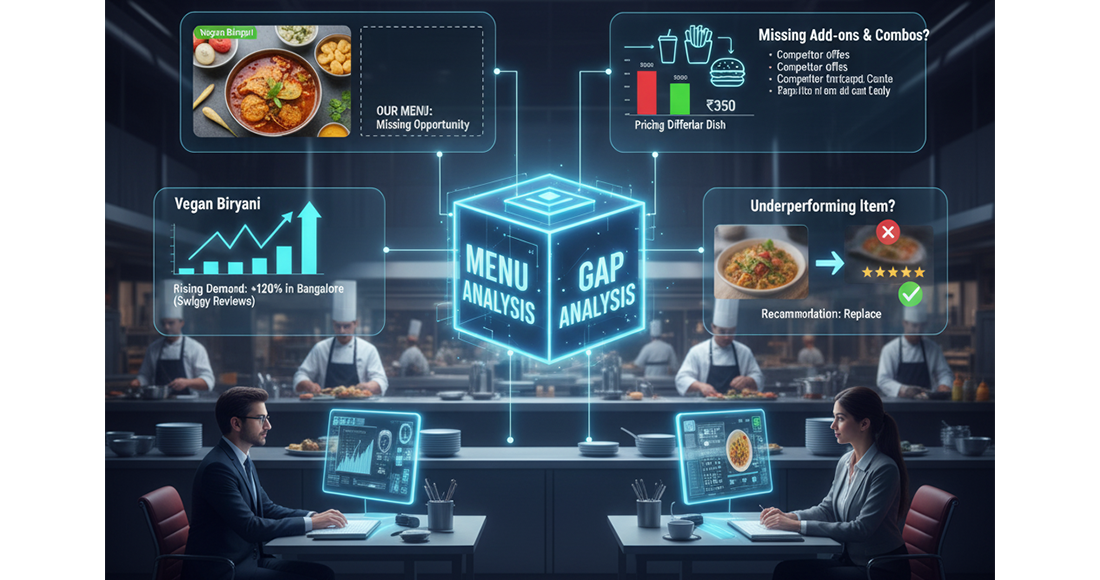
- Which dishes are trending locally that we don’t offer?
- Are competitors pricing similar dishes differently?
- What add-ons or combos are missing from our menu that others capitalize on?
- Which menu items are underperforming and should be replaced?
For example, if reviews on Swiggy show rising demand for “vegan biryani” in Bangalore but no local kitchens offer it, there’s a clear menu gap opportunity.
The Role of Web Scraping in Restaurant Growth
Web scraping automates the extraction of publicly available data from platforms where customers and competitors interact. For restaurants, scraping provides:
- Competitor Insights – Prices, menus, reviews, offers.
- Location Intelligence – Delivery coverage, density, and gaps.
- Menu Trends – Popular dishes by city or cuisine type.
- Consumer Sentiment – Ratings and review-based feedback.
- Promotions & Offers – Competitor discounting strategies.
Instead of relying on outdated market reports, restaurants can use real-time scraped datasets to guide daily decisions.
What Data Can Be Scraped for Location & Menu Analysis?
1. Restaurant Listings
- Name, location, cuisine type.
- Delivery areas and radius.
- Operating hours.
2. Menus & Dishes
- Item names, descriptions, categories.
- Add-ons, combos, seasonal dishes.
- Nutritional details when available.
3. Pricing
- Dish pricing across competitors.
- Discount percentages.
- Platform-specific surge pricing.
4. Customer Reviews
- Ratings (stars).
- Sentiment from text reviews.
- Common complaints (taste, packaging, price).
5. Promotions
- Offers (buy-one-get-one, cashbacks).
- Regional festival discounts.
6. Location Coverage
- Restaurant density in specific neighborhoods.
- Cuisine gaps in delivery zones.
Use Cases: Web Scraping for Restaurant Growth
1. Location Intelligence
By scraping restaurant density and delivery coverage, brands can identify underserved neighborhoods. For instance, if an area has 30 Chinese restaurants but only 2 Mexican outlets, that’s a growth opportunity.
2. Menu Gap Analysis
Scraping menus reveals missing items in your category. If competitors offer a “family biryani pack” but your kitchen doesn’t, you can introduce it to boost orders.
3. Pricing Strategy
Figure out the competitors’ prices for the identical menu item at different locations and then price your dish accordingly.
4. Consumer Sentiment Benchmarking
Scrape reviews to identify dishes customers love (to emulate) and pain points (to avoid).
5. Promotion Design
Observe competitor discount strategies and craft more persuasive offers aligned with local market needs.
6. Expansion Planning
Before opening a new outlet, scrape delivery app listings to analyze demand vs. supply for your cuisine in that area.
Benefits of Web Scraping for Restaurants
- Data-Driven Decisions – Move beyond guesswork in location selection and menu planning.
- Faster Innovation – Identify food trends early and adapt menus accordingly.
- Increased Profit Margins – Optimize pricing and reduce waste by aligning with demand.
- Customer Retention – Offer dishes customers want, at the prices they expect.
- Regional Customization – Tailor menus to local tastes instead of using a one-size-fits-all strategy.
- Competitive Advantage – Stay one step ahead of rivals with continuous intelligence.
Challenges in Restaurant Data Scraping
While scraping is powerful, challenges exist:
- Dynamic Website Structures – Frequent updates to delivery apps may break scrapers.
- Anti-Scraping Barriers – IP blocking, CAPTCHAs, and rate limiting.
- Data Quality Issues – Raw data may be inconsistent or incomplete.
- Legal & Ethical Risks – Scraping must respect terms of service and data privacy laws.
- Scalability – Collecting data across thousands of outlets requires strong infrastructure.
Best Practices for Restaurant Web Scraping
- Define Scope Clearly – Focus on specific goals like “menu gap analysis” or “location coverage.”
- Ensure Accuracy – Clean and standardize data before analysis.
- Automate Updates – Schedule scraping for weekly or daily insights.
- Integrate Analytics – Feed cleaned data into BI dashboards for actionable insights.
- Maintain Compliance – Follow ethical scraping practices that respect regulations.
- Leverage Experts – Outsource to specialized scraping providers for scalability and reliability.
The Future of Data-Driven Restaurant Growth
Restaurants that embrace data intelligence today will dominate tomorrow. With AI and web scraping, the future could bring:
- Dynamic Menus that adapt automatically to local demand.
- AI Pricing Models that optimize in real time based on competitor moves.
- Predictive Analytics that forecast cuisine trends before they become mainstream.
- Personalized Menus tailored to individual customers’ dietary preferences.
The convergence of AI, location intelligence, and menu optimization will redefine how restaurants grow in the next decade.
Scaling Restaurant Chains with Location & Menu Analysis
For single outlets, scraping is useful. But for chains with multiple branches, it’s transformative:
- Benchmark performance across outlets.
- Tailor menus to each city’s demand.
- Identify new expansion zones.
- Create consistent but regionally customized strategies.
Data scraping is no longer optional—it’s the foundation of scalable restaurant growth.
Conclusion: The Power of Food Data Scraping in Restaurant Growth
These days, restaurants operate in an ultra-competitive marketplace, in which a restaurant’s success depends on being in the right location with the right menu. No more guesswork or hunches.
With the application of web scraping for location intelligence and menu gap analysis, a restaurant can:
- Identify underserved neighborhoods.
- Customize menus as per regional tastes.
- Keep pace with the competitors in real time.
- Expand strategically and profitably.
The entire transformation depends on food data scraping—a tool that can unify scattered data sources on the internet into actionable insights. For those seeking sustainable growth, food data scraping is not merely a useful extra; it is the very thing keeping restaurants competitive in the world of digital-first dining.
Leave feedback about this