
Introduction
In this complicated food delivery scenario, where everything is fast-paced, each restaurant and label has to be at its level best in the process, apart from being competitive, profitable, and customer-centric. In the fast-evolving food delivery landscape, platforms like Uber Eats are radically turning into devices indispensable to millions of end consumers who are nowadays in need of speed, selection, and cost-effectiveness in their every single order. For restaurants and firms, Uber Eats is more than just a delivery channel-it is also a data powerhouse.
Every product up on a menu, a price adjustment, a discount, an analysis study, and all reviews listed on Uber Eats disclose valuable customer attitudes, rival strategies, and market dynamics, but the key to all of these details lies in analyzing mass records by tapping into the Uber Eats API.
This input has been arranged in a well-structured restaurant data feed provided with the Uber Eats API to facilitate the establishment of custom scraping solutions. This information can be used for market competitive modeling, pricing optimization, menu engineering, and customer sentiment analysis.
In this blog, we’ll explore:
- Why Uber Eats data is vital.
- What the Uber Eats API offers.
- How to extract and process data.
- Use cases for restaurants, FMCG brands, and analysts.
- Benefits, challenges, and best practices.
- Why Food Data Scraping is the backbone of smarter restaurant insights.
Why Uber Eats Data Matters
Uber Eats is one of the largest food delivery platforms globally, operating in over 6,000 cities. Its scale alone makes it a rich source of consumer and market data.
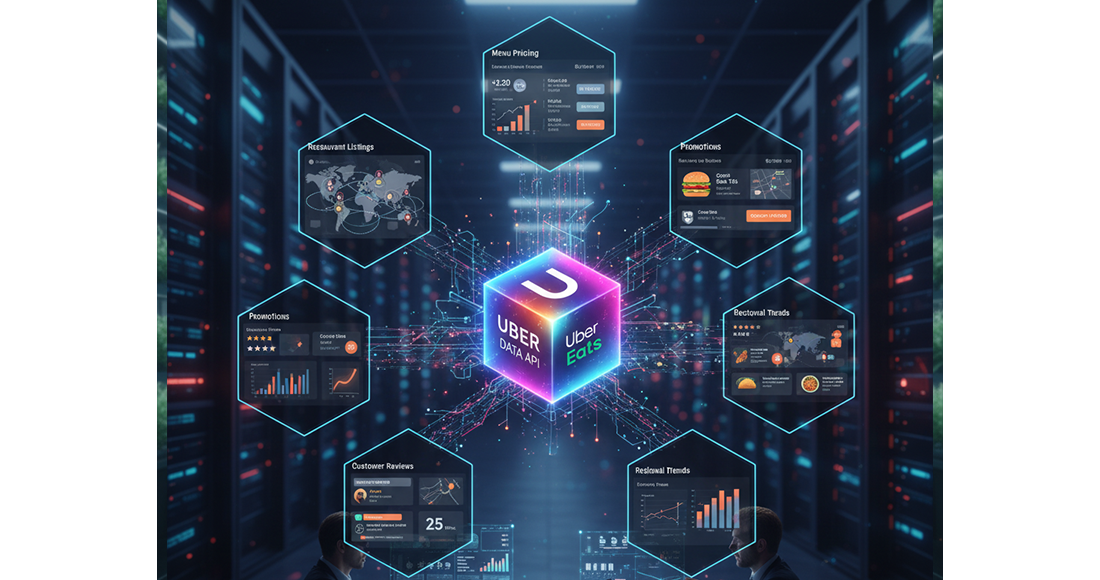
Insights Uber Eats Data Provides:
- Restaurant Listings – Names, categories, cuisines, and delivery radius.
- Menu Pricing – Item-level pricing, add-ons, and combos.
- Promotions – Discounts, loyalty deals, and surge pricing.
- Customer Reviews – Ratings and feedback for quality analysis.
- Delivery Metrics – Estimated times, fees, and surge delivery charges.
- Regional Trends – Popular cuisines and dishes by city or neighborhood.
For restaurants, FMCG brands, and analysts, Uber Eats data is a direct window into real-time consumer behavior.
What Is the Uber Eats API?
The API is important because it enhances the structure used in an environment of case where systems cannot communicate. API is an abbreviation for Application Programming Interface where, in this case, Uber Eats API, developers or businesses want to access point-of-sale data of restaurant food in a structured way from restaurant menus to orders.
Key Data Accessible via Uber Eats API:
- Restaurant Data: Name, cuisine type, rating, and delivery radius.
- Menu Data: Categories, dish names, prices, and availability.
- Order Data: Historical orders (for integrated partners).
- Reviews: Customer ratings and comments.
- Delivery Data: Time estimates and surge pricing patterns.
When official APIs are limited, businesses often rely on custom scraping APIs to capture the same information while maintaining scalability.
How to Extract Data Using the Uber Eats API
Step 1: Get API Access
- Partner with Uber Eats for developer or business access.
- Alternatively, set up custom scraping solutions using Python libraries or cloud scraping APIs.
Step 2: Define Scope
Identify whether you need menus, pricing, promotions, or reviews.
Step 3: Send API Requests
Example (Python pseudo-code):
import requests
url = “https://api.ubereats.com/v1/restaurants?location=NewYork”
headers = {“Authorization”: “Bearer YOUR_API_KEY”}
response = requests.get(url, headers=headers)
data = response.json()
for restaurant in data[‘restaurants’]:
print(restaurant[‘name’], restaurant[‘cuisine’], restaurant[‘rating’])
Step 4: Store Data
Save the structured data in SQL, MongoDB, or cloud-based storage.
Step 5: Clean & Normalize
- Standardize categories and units.
- Remove duplicate entries.
- Ensure consistent currency and pricing formats.
Step 6: Analyze & Visualize
- Use dashboards (Tableau, Power BI).
- Perform sentiment analysis with NLP tools.
- Benchmark pricing against competitors.
Key Insights from Uber Eats Data

- Menu Pricing Intelligence
- Identify gaps in competitor pricing strategies.
- Consumer Sentiment
- Track satisfaction and complaints in reviews.
- Promotion Tracking
- Benchmark discounts and loyalty offers.
- Regional Demand Analysis
- Discover popular cuisines and dishes by city.
- Delivery Benchmarking
- Compare delivery charges and estimated times.
Use Cases of Uber Eats API & Data Extraction
1. Restaurants & Cloud Kitchens
- Optimize menus by identifying trending dishes.
- Adjust pricing dynamically based on competitor moves.
- Monitor customer reviews for service improvements.
2. FMCG & Packaged Food Brands
- Track SKU visibility in Uber Eats restaurant menus.
- Compare brand presence against competitors.
- Monitor discounting trends for packaged products.
3. Delivery Platforms
- Improve ranking algorithms with sentiment and pricing insights.
- Identify high-performing restaurants for partnerships.
4. Market Researchers & Analysts
- Forecast regional cuisine trends.
- Study consumer spending behavior in urban centers.
5. Investors
- Evaluate restaurant or brand performance before funding decisions.
Benefits of Using the Uber Eats API
- Real-Time Market Intelligence
Keep up with live menu and pricing changes. - Scalability
Collect thousands of records across multiple cities. - Data-Driven Decisions
Design strategies backed by evidence, not assumptions. - Customization
Focus on the exact data points you need. - Efficiency
Save time and resources compared to manual tracking.
Challenges in Uber Eats Data Scraping
- Rate Limits: APIs may restrict daily calls.
- Dynamic Updates: Menus and offers change frequently.
- Anti-Scraping Measures: CAPTCHA, IP blocks, and detection systems.
- Data Cleaning: Raw scraped data requires heavy normalization.
- Compliance: Businesses must respect Uber Eats’ terms of service.
Best Practices for Uber Eats Data Extraction
- Set Clear Objectives
Define whether you’re scraping for menus, prices, or reviews. - Automate Updates
Schedule hourly or daily scraping to keep datasets fresh. - Normalize Data
Standardize currency, categories, and units. - Use Proxy Infrastructure
Avoid detection and IP bans with rotation. - Ensure Compliance
Stay ethical and respect data privacy regulations. - Leverage Analytics
Turn raw data into dashboards and actionable intelligence. - Partner with Experts
Work with professional scraping providers for scalability.
The Future of Uber Eats Data Intelligence
Uber Eats data scraping is foreseen to improve itself through progressive engagements in AI and predictive analysis. Soon after 2025, AI will not present with increased data sizes, getting more current post 2025:
- I.-Enabled Prediction: Forecast the high-growing cuisines during different situations.
- Dynamic Pricing Ways: Mechanical means to adjust the pricing according to the demands it leads to.
- Targeted Offers: Personalize what kind of offers would work well within different customer segments.
- Alignment of Procurement: Availability and procurement plan, taking into account the demand.
Uber Eats data will not only inform businesses but also enable predictive, proactive strategies.
Scaling Businesses with Uber Eats Data
Uber Eats data is crucial in ensuring the competitiveness of several local restaurants when it is being used in the context of their delivery radius range. And, for multi-location chains, it guarantees identical output from their places. Moreover, in the case of FMCG brands, it becomes the source of their SKU-level insights. And for investors, it mysteriously reveals high-level consumption.
Every piece of the Uber Eats API data extraction adds to the growth of local restaurants.
Conclusion: The Essential Role of Food Data Scraping
The Uber Eats application moves beyond the horizon of a simple delivery service, becoming a real-time information system that mimics consumer choices, market behaviors, and competitor strategies.
By leveraging the Uber Eats API for data extraction, businesses can:
- Track competitor pricing and promotions.
- Optimize menus and delivery strategies.
- Monitor consumer sentiment at scale.
- Plan expansions based on regional demand.
At the foundation of this intelligence is Food Data Scraping—the process of converting scattered online data into structured, actionable insights. For restaurants, brands, and analysts, food data scraping is not just a technical solution—it is the foundation of sustainable growth in the online food delivery economy.