

In the backdrop of the food industry of 20 trillion, it ranked among the most volatile and competitive in the world. From farm to fork, every move-from sourcing of ingredients, dispatch, and menu pricing-is a high-risk game of consumer behavior, commodity prices, and supply chain stability. By 2025, the window between success and stagnation is now measured in milliseconds, while high-fidelity real-time data represents the secret weapon of the fastest-growing food businesses.
This is where Web Scraping Food Data turns the dial from a technical option to an outright business imperative. Extraction of Food Industry Data from the internet worldwide-restaurant menus, delivery applications, commodity exchanges, and social media from reviews-is turning into a strategic million-dollar advantage. Analysts estimate that, driven mainly by industries such as FoodTech and e-commerce, the broader web scraping market will continue to sustain its double-digit growth. Hence, Web Scraping Use Cases for the Food Industry have evolved into highly sophisticated AI-driven intelligence systems.
The core challenge in the food sector is fragmentation. Data on what people are eating, where they are buying it, and how much they’re willing to pay is scattered across thousands of food delivery platforms, local restaurant websites, and grocery e-commerce portals. Manual data collection is impossible at the required scale. Web scraping automates this process, providing the clean, structured dataset needed to power the next generation of business intelligence and AI models.
Here are the Top 5 Web Scraping Use Cases in the Food Industry in 2025 that are fundamentally reshaping market strategy, operational efficiency, and profitability.
1. Real-Time Menu and Pricing Intelligence: The Dynamic Pricing Imperative
The idea of a static menu or fixed grocery prices no longer applies in 2025. Since there are so many platforms to order food from (Uber Eats, DoorDash, local services), all things grocery continue to be very competitive, and with prices moving according to local demand, time of day, competitor promotions, and even the weather, the price one could pay is truly dynamic. Price monitoring, in essence, is no longer something that occurs quarterly; it has turned into a practically minute-by-minute fight.
The Competitive Edge of Data-Driven Pricing
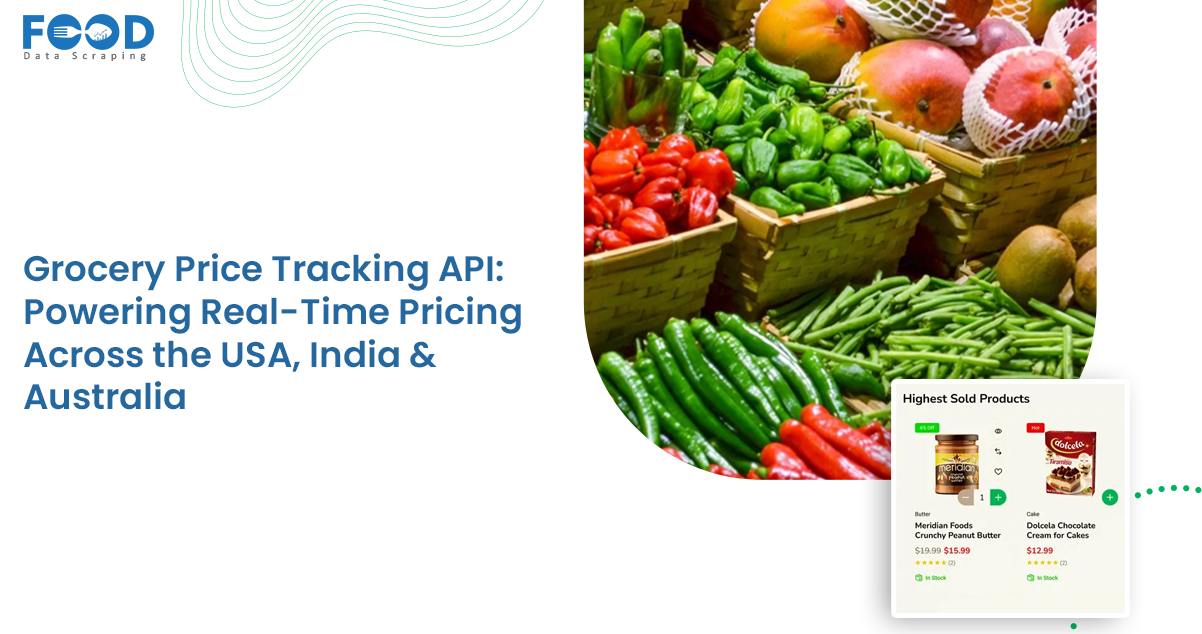
Web Scraping Food Data for this use case involves automatically collecting every competitor’s menu item, its price, any active promotions (e.g., “50% off for first-time orders”), and associated costs like delivery fees across all relevant platforms and geographic zones.
- For Restaurants and Food Delivery Platforms: This intelligence allows for true Dynamic Pricing. If a competitor drops the price of their signature burger from $14.99 to $12.99 at 5:00 PM on a Friday, the scraping system immediately alerts the business intelligence (BI) platform. The restaurant can then automatically adjust its own price or offer a targeted bundle to remain competitive, capturing market share without destroying profit margins on all This proactive adjustment—sometimes happening multiple times a day—is essential for optimizing the Average Order Value (AOV).
- For Grocery Retailers: E-commerce grocers use scraping to track rival prices, stock levels, and product descriptions (e.g., organic, gluten-free, local) on specific products. By comparing millions of data points, they can ensure their pricing is optimally positioned—not necessarily the cheapest, but competitively priced for maximum customer attraction and sustained profitability.
Why it Matters in 2025: High inflation and economic volatility have made consumers exceptionally price-sensitive. Businesses that use scraped data to offer personalized, competitive pricing are retaining customers and boosting order frequency, while those relying on manual checks are rapidly losing market relevance.
2. Supply Chain and Commodity Price Monitoring
Ingredients are the biggest variable expense for any food manufacturer, distributor, or major restaurant. Price-fixing of ingredients is a highly complex and risky activity with global supply chains still running on post-COVID disruptions, geopolitical uncertainties, and climate changes, causing crop failures.
Shift From Reactive to Predictive Cost Management
Scrape Food Data further extends into other prices that consumers pay. This use case focuses on structured data extraction from upstream sources:
- Commodity Exchanges: The spot and futures prices in real time for selected commodities, especially wheat, corn, coffee, sugar, and cocoa.
- Supplier & Vendor Catalogs: Prices and availabilities of thousands of very specific raw ingredients (grade A salmon, specified packaging material, etc.) from supplier sites and B2B marketplace sites.
- Logistics and Freight: Scraping publicly available data on freight rates, port congestion, and shipping times.
Aggregated real-time data then makes a seamless ingress into Enterprise Resource Planning systems and supply-chain-forecasting models.
- Cost Forecasting and Hedging: With soybean oil futures scraped for prices, a food manufacturer can say with better certainty what production costs will be for the next six months. With such foresight, they can put in large orders for ingredients when prices are low or start tweaking their product formulations well before the price surge.
- Supplier Risk Management: While scraping news feeds, industry alerts, and databases of quality certifications, companies monitor the performance and financial stability of their suppliers. The scraping system flags an issue the moment a key supplier faces a natural disaster or a food safety violation in a critical region, thus allowing the buyer to shift swiftly to a dependable alternative before a shortage occurs.
Why it Matters in 2025: Supply chain agility has received much attention as a result of global economic uncertainties and climate instability. This application of Extract Food Industry Data thereby transforms the supply chain function from a reactive cost center to a proactive profit protector.
3. Consumer Sentiment and Review Analytics: Beyond the 5-Star Rating
A five-star rating is great, but it tells you very little about why the customer loved or hated their experience. The true value lies in the unstructured text—the reviews on Yelp, Google, TripAdvisor, and the comments on social media delivery apps. This vast, unfiltered dataset of public opinion is a goldmine for product improvement and brand reputation management.
Turning Text into Tactical Insights
This use case uses Web Scraping Food Data to systematically collect millions of customer reviews and social media comments. Once collected, Natural Language Processing (NLP) and machine learning are applied for Sentiment Analysis.
- Granular Product Improvement: Instead of just seeing a 3-star average, a national pizza chain can scrape thousands of reviews and discover that 70% of comments mentioning their “pepperoni pizza” use the keywords “greasy” or “too salty.” This precise, data-driven insight immediately informs the R&D team to adjust the recipe or the cheese-to-topping ratio.
- Real-Time Service Correction: A food delivery service can scrape review platforms and identify clusters of complaints about a specific ghost kitchen or a regional delivery fleet. Alerts can be generated when a spike in negative sentiment related to “delivery time” or “cold food” occurs in a particular city, allowing local management to intervene within hours rather than waiting for weekly reports.
- Brand Reputation Management: Scraping social platforms for mentions of the brand’s name, popular products, and executive commentary helps in proactive crisis management. A potential PR issue can be identified in its infancy, allowing the communications team to respond rapidly before a local complaint turns into a viral disaster.
Why it Matters in 2025: In the instant-feedback culture of delivery apps and social media, brand reputation is fragile. Leveraging web scraping for detailed sentiment analysis provides a continuous, high-resolution view of customer experience, directly driving loyalty and retention.
4. Market Research, Trend Spotting, and Menu Optimization
Staying ahead of the next culinary wave is how food businesses win. Are customers shifting from ketogenic diets to Mediterranean? Is the demand for oat milk about to spike in a new region? What are the ingredient prices and menu items of successful new competitors in a target city? Answering these questions requires comprehensive, wide-ranging Scrape Food Data.
The Future of Food Innovation
This is perhaps the broadest of the Web Scraping Use Cases for Food Industry. It involves scraping diverse sources to capture the early signals of change:
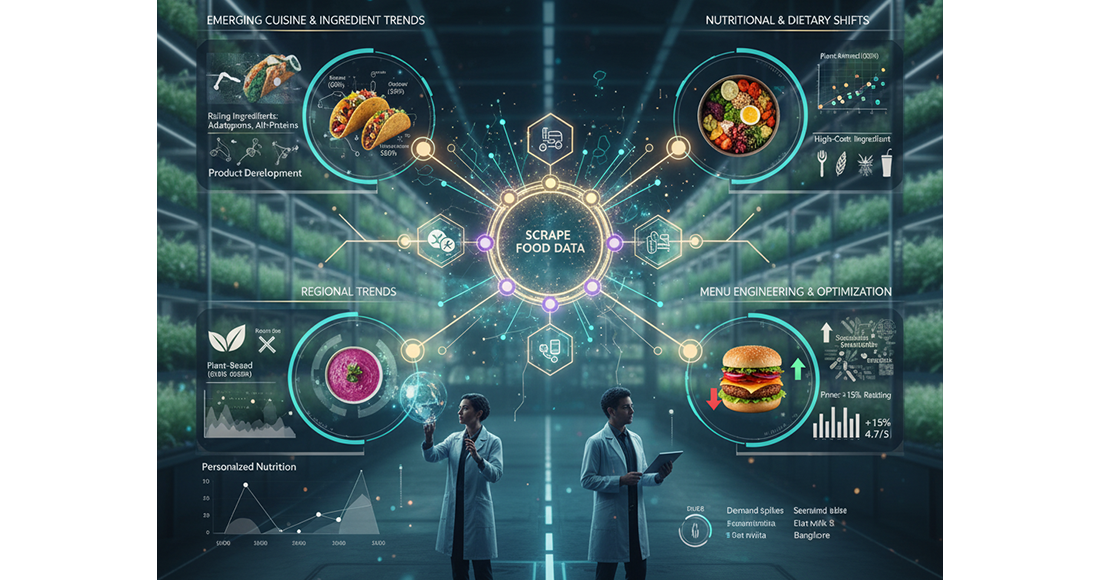
- Emerging Cuisine and Ingredient Trends: Scraping food blogs, food media sites, recipe repositories, and high-end restaurant menus to identify rising ingredients (e.g., adaptogens, alternative proteins) or cuisine fusions (e.g., Korean-Peruvian). This is critical for Product Development and Innovation.
- Nutritional and Dietary Shifts: Collecting and analyzing menu data from thousands of restaurants and grocery sites, focusing on tags like “plant-based,” “gluten-free,” “high-protein,” or “keto.” In 2025, personalized nutrition is a huge trend, and data shows where businesses to focus their product line extensions.
- Menu Engineering: For existing restaurants, Food Data Scraping helps optimize the current menu. By scraping the performance data (ratings, reviews) of similar dishes in the local market and combining it with internal cost data, restaurants can strategically price and position their offerings for maximum profitability, a process known as Menu Optimization. If a low-performing item uses a high-cost ingredient that is trending downward in competitor menus, it’s a clear signal to modify or remove it.
Why it Matters in 2025: The shift toward plant-based, functional, and sustainably sourced foods is not just a trend—it’s a permanent market transformation. Businesses that use scraped data to rapidly prototype and launch products aligned with these trends will capture the next generation of consumer spending.
5. Food Safety and Regulatory Compliance Monitoring
Times are changing, but our food safety and compliance still remain. There are daily food safety alerts issued, product recalls, or new labeling requirements introduced by government bodies such as the FDA or USDA, and other international bodies, just to name a few. For a large importer, manufacturer, and multi-state retailer of foods, tracking such information manually is a major administrative exercise filled with high risk.
Under the Risk Management Automations
This use case, therefore, exploits Extract Food Industry Data to automate and de-risk compliance operations. Scraping systems are thus set up to monitor specific authoritative sources:
- Official Recall Databases: Governmental websites are continuously monitored for new notices of food recalls by means of warnings about contamination or product safety, usually specifying a particular brand name, lot number, or even type of ingredient.
- Regulatory Bulletins: Scraping regulatory bodies for new or amended requirements, such as changes in nutritional labeling laws, import/export tariffs, or food additive approvals.
- Supplier Certification and Audit Data: Monitoring public-facing databases for recent safety certifications, audit results, and compliance scores of third-party suppliers to ensure that the entire supply chain adheres to required standards.
- Rapid Response: With the issuing of a recall for a specific ingredient, the scraping system sends a real-time alert so that retailers may remove affected products from shelves immediately, thus reducing consumer risk, regulatory penalties, and negative publicity.
- Proactive Compliance: Manufacturers may scrape proposed regulatory changes and begin adjusting packaging, labeling, or product formulations months before such rules enter into force, preventing costly last-minute overhauls.
Why would it contain any importance in 2025: Being post-pandemic, the world is under much regulatory scrutiny. Web scraping would now provide an extra layer of automated risk intelligence, thereby allowing large-scale food businesses to achieve compliance at scale and address both consumer welfare and their own legal impact.
Conclusion: The Data-Driven Future of Food
It is being called the SOP of Web Scraping Food Data by 2025- an AI scraping tool with the option to adapt to complicated JavaScript-heavy websites, a cloud infrastructure invented for scaling, and legal structures and governance developed along the way.
From food service giants having strikes at billion-dollar valuations of delivery platforms to local food retailers at the proper margin, the best will treat the Web openly for instant research. Using Top 5 Web Scraping Use Cases in the Food Industry, they stop relying on random anecdotal evidence and intuition and start making decisions based on millions of real-time data points. For instance, Slicker Scrape Food Data means pricing a takeout pizza, forecasting the cost of cocoa for next quarter’s production run, or spotting the next viral ingredient trend. The competitive advantage lies with companies that scrape food data, run quick analyses, and make decisions based on their insights.
Leave feedback about this