

Introduction
India’s grocery shopping experience has completely metamorphosed over the past five years. Earlier, customers would spend quite a time in supermarkets just to find the best deal on goods, but today the necessities of life are delivered to the doorsteps of households instantly by just a few taps, whether groceries or fresh produce, or even everyday essentials.
At the core level of this revolution are three giants in India: BigBasket, Zepto, and Blinkit, all of which make such fast business promotion through the e-grocery channels. Each of these platforms has refashioned customer expectations over its product sets by its own means:
- BigBasket pioneered online grocery shopping with a focus on variety and reliability.
- Zepto disrupted the market with its bold 10-minute delivery promise.
- Blinkit (formerly Grofers) reinvented itself to cater to the fast-paced q-commerce demand.
But which platform is best in terms of cost comparison? With costs being more of a concern to cost-conscious customers, the same also calls for businesses—including restaurants and branded FMCGs—to take into account the landscape of the platforms in terms of competitive intelligence.
This blog explores BigBasket vs Zepto vs Blinkit price comparison, analyzing their strategies, data points, and how businesses can leverage Food Data Scraping for smarter decisions.
The Rise of Quick Commerce in India
Before diving into comparisons, let’s understand why q-commerce is booming in India.
- Convenience: Grocery delivery services are preferred by consumers because they are quicker than walking to a store.
- Urbanization: To meet the demands of the busy professionals living in a metropolis.
- Price Sensitivity: Buyers tend to compare prices on multiple apps before ordering.
- Technology & Data: Pricing can be changed dynamically with the help of AI and data scraping in platforms that are focusing on big data analytics.
In India, by 2025, immediate trade is expected to grow beyond 10 billion dollars, with BigBasket, Zepto, and Blinkit facing each other in business.
Price Comparison Approach
To compare prices fairly, let’s evaluate across these categories:
- Fresh Produce (fruits, vegetables)
- Staples & Essentials (rice, wheat, oil, pulses)
- Dairy & Beverages (milk, juices, soft drinks)
- Packaged Foods (snacks, biscuits, noodles)
- Household Products (detergents, cleaning supplies)
We’ll also consider promotions, delivery fees, and loyalty programs.
BigBasket: Pricing and Strategy
BigBasket, backed by the Tata Group, is the veteran of India’s online grocery segment.
Pricing Model:
- Competitive but slightly higher than Blinkit or Zepto for fresh produce.
- Relies heavily on seasonal discounts and loyalty programs.
- Offers bulk purchase discounts, which appeal to families.
Strengths:
- Wide product variety, including niche categories like organic and imported foods.
- Subscription model (BB Star Membership) for free delivery and special discounts.
Weaknesses:
- Delivery times are slower compared to Zepto or Blinkit.
- Higher minimum order value in some regions.
Example:
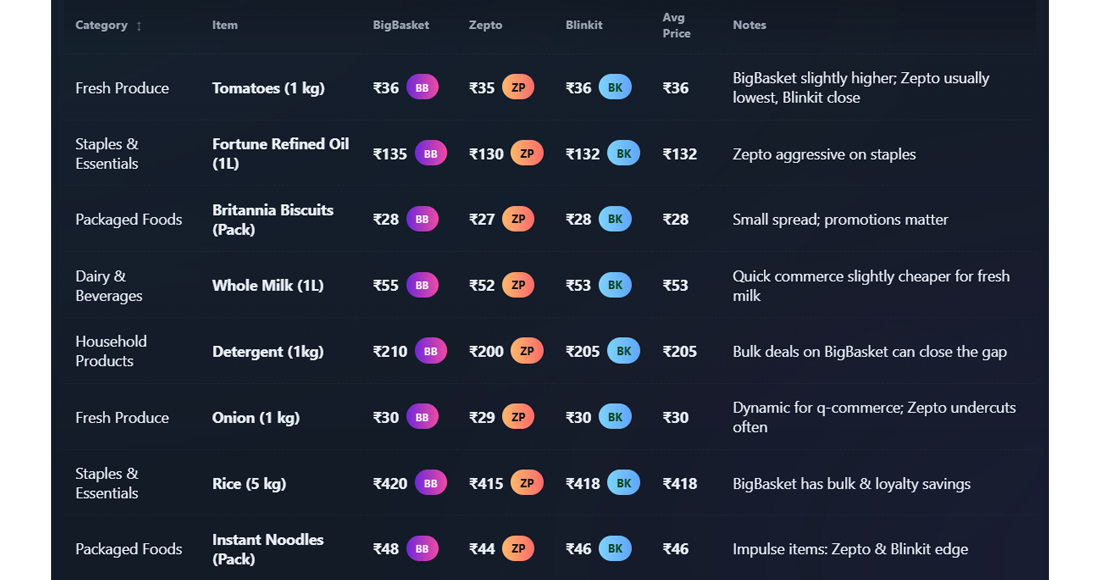
- Tomatoes (1 kg): ₹36–38
- Fortune Refined Oil (1L): ₹135
- Britannia Biscuits (Pack): ₹28
Zepto: Pricing and Strategy
Zepto is the disruptor that made 10-minute grocery delivery a norm in metro cities.
Pricing Model:
- Uses dynamic pricing to stay competitive.
- Often matches or undercuts Blinkit on essentials.
- Promotions targeted to frequent, smaller basket sizes.
Strengths:
- Aggressive pricing in staples and popular snacks.
- Focus on young, urban customers with impulse purchases.
Weaknesses:
- Limited product range compared to BigBasket.
- Operates mostly in metros, with fewer offerings in smaller towns.
Example:
- Tomatoes (1 kg): ₹34–36
- Fortune Refined Oil (1L): ₹130
- Britannia Biscuits (Pack): ₹27
Blinkit: Pricing and Strategy
Blinkit, acquired by Zomato, rebranded from Grofers and reinvented itself for q-commerce.
Pricing Model:
- Competitive and often lower than BigBasket, but slightly higher than Zepto.
- Focuses on promotions and cashback offers.
- Collaborates with banks and wallets for payment-linked deals.
Strengths:
- Strong presence across metro and Tier-2 cities.
- Discounts tied to Zomato Gold or Zomato wallet usage.
Weaknesses:
- Smaller assortment compared to BigBasket.
- Pricing may fluctuate during peak hours.
Example:
- Tomatoes (1 kg): ₹35–37
- Fortune Refined Oil (1L): ₹132
- Britannia Biscuits (Pack): ₹28
Comparative Analysis: BigBasket vs Zepto vs Blinkit
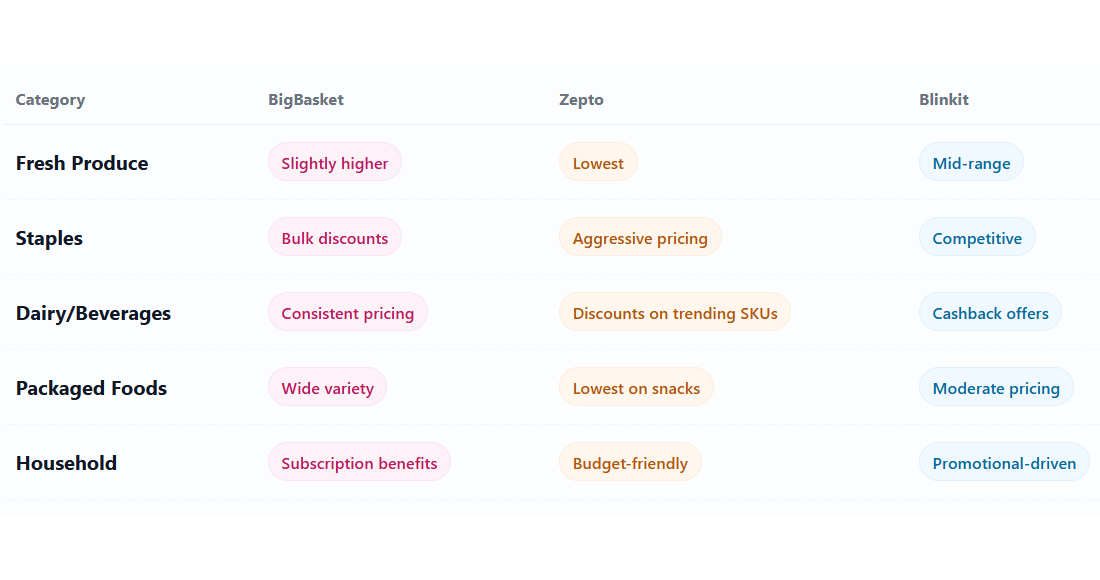
| Category | BigBasket | Zepto | Blinkit |
| Fresh Produce | Slightly higher | Lowest | Mid-range |
| Staples | Bulk discounts | Aggressive pricing | Competitive |
| Dairy/Beverages | Consistent pricing | Discounts on trending SKUs | Cashback offers |
| Packaged Foods | Wide variety | Lowest on snacks | Moderate pricing |
| Household | Subscription benefits | Budget-friendly | Promotional-driven |
Winner by Category:
- Fresh Produce → Zepto
- Staples → Zepto
- Dairy & Beverages → BigBasket (consistency)
- Packaged Foods → Zepto
- Household → BigBasket
Overall, Zepto wins on aggressive pricing, while BigBasket leads in variety and consistency, and Blinkit excels in promotions and partnerships.
Role of Promotions and Discounts
While base prices differ, promotions significantly influence final costs:
- BigBasket → Membership discounts (BB Star).
- Zepto → Flash sales and cart-based offers.
- Blinkit → Cashback and wallet-linked deals.
For price-sensitive customers, these offers often outweigh minor differences in base pricing.
User Behavior Insights from Pricing
Scraping and analyzing data from these platforms reveals:
- Customers tend to order small baskets more frequently (Zepto, Blinkit).
- Families prefer bulk orders (BigBasket).
- Urban millennials respond more to flash deals and time-limited offers.
- Loyalty programs influence repeat purchases.
Benefits of Price Scraping for Businesses
Businesses can use price scraping across BigBasket, Zepto, and Blinkit to:
- Benchmark competitors in real time.
- Optimize pricing strategies to increase market share.
- Identify high-demand categories for promotions.
- Track regional price variations for supply chain planning.
- Design dynamic pricing models aligned with competitor behavior.
Challenges in Price Comparison Scraping
- Dynamic Updates: Prices and discounts change frequently.
- Anti-Scraping Mechanisms: Platforms may block excessive data requests.
- Data Cleaning Needs: Normalizing product categories across platforms is complex.
- Regional Variations: Prices differ by PIN code, requiring large-scale scraping.
Best Practices for Price Scraping
- Get Clear Goals: Concentrate on the biggest classifications that matter most.
- Automate Scraping: Set it to run by hour or daily tweak.
- Normalize Data: Formalized product naming and data units for high reliability.
- Ethical Scraping Methods: Treat all in compliance with and privacy laws.
- Leverage Analytics: Scrape off all scraped data better on BI dashboards for leading-action insights.
- Outsource Expertise: Use a very good scraping company that gives the right value for the extent of scalability.
Future of Grocery Price Intelligence
By 2025 and beyond, price comparison scraping will integrate with AI to:
- Predict competitor promotions before they launch.
- Automate pricing adjustments in real time.
- Personalize offers for customer segments.
- Forecast demand during festivals or inflation cycles.
The future will belong to businesses that adopt AI-driven pricing intelligence powered by data scraping.
Conclusion: The Role of Food Data Scraping
In essence, by setting out a competitive landscape between BigBasket and Zepto, as well as Blinkit, it can be said that the consumer will understand that the element of pricing is of value not only as a concern usually affecting money outflow but in respect of strategy, promotions, and how the customer perceives the price.
In terms of services, each has its strengths: BigBasket has a wide range of products, Zepto offers speed at the cheapest price, and Blinkit builds loyalty through cashback. Customer interests can align with any of the trio features that stand out: pricing as a low-price choice, becoming more rapid as far as delivery services provided, or offering a wide variety of product assortments. In most cases, analyzing data in Food Data Scraping may bring many benefits in terms of the effectiveness of pricing operations in business.
Food data scraping enables:
- Real-time competitor tracking.
- Smarter pricing strategies.
- Promotion benchmarking.
- Regional demand insights.
In the fast-growing e-mart and quick commerce industry, Food Data Scraping is not just a tool—it’s the foundation for competitive advantage and sustainable growth.
Leave feedback about this